
During the economically chilling month of April, I typically lose my enthusiasm for labor. Indeed, during this past tax season, REIT Wrecks emitted nary a vowel. Unfortunately, CMBS bankers have no such luxury, lest they have no work at all.
The market for CMBS remains stalled, and the lack of credit availability is stunting what appears to be the beginning of a bottom in commercial real estate, particularly in primary markets. With cap rates moving rapidly down, especially in certain primary markets, now should be the time to make hay with CMBS:
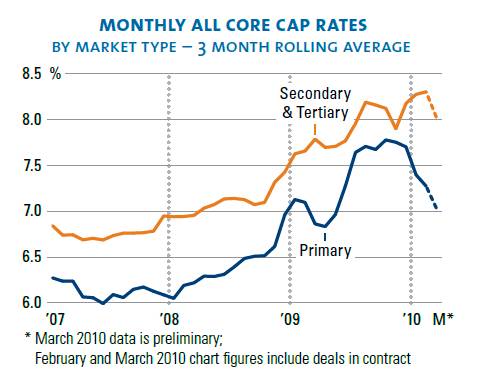
The nascent recovery is causing more investors to take a look at CMBS, including insurance giant Primerica, and that is causing CMBS bankers to start picking up their phones again.
In the first multi-borrower deal since the crash, RBS closed a $310 million deal with stong demand and very competitive pricing in April, but it was a far cry from the halcyon days of 2006. The deal included by only six loans (and none of them were warehoused for more than a week), it had no B-piece and it was privately placed. The small deal size resulted in the deal being over-subscribed, and demand might have been even stronger had the deal been publicly registered.
The RBS deal is not the only sign of life in CMBS. PNC and Bank of America are both resuming their conduit lending programs, and Bridger Commercial Funding announced late last year that it would resume its own conduit program, the first such resumptions since 2008. Most notable of all, JP Morgan is still struggling working on the first multi-borrower CMBS deal since 2008, which could include up to 25 loans worth $1 billion.
The CMBS market is clearly starting to defrost, but it’s by no means thawed. The critical piece in any large revival in the CMBS market is still missing, and that is the B piece buyers. Last month, I spoke to a large but still very much former B piece buyer about the RBS deal. This person remarked that traditional B piece buyers were “thoroughly incapable” of investing in any new deals, which is why the RBS deal did not include a traditional B piece structure.
JP Morgan is still shopping the B piece for its deal, and it appears to be slow going, mostly because this is what happened to B piece buyers who bet wrong. Many B Piece buyers had themselves been using heavy doses of leverage to fund their purchases – and that is no longer available. More importantly, most are buried in legacy portfolios full of defaults, workouts and upside down income streams.
The JP Morgan deal will be a bellwether in the current environment, assuming the firm can find new investors for B pieces. Amazingly, if CMBS credit starts to come back to commercial real estate in a sustainable way, at the same time that the recovery in primary markets continues, all this time spent waiting for Godot may have actually been for naught.


ShareThis


{ 6 comments… read them below or add one }
Did you see where New York Mortgage Trust (NYMT) recently invested $750k in Bridger’s parent company? (http://finance.yahoo.com/news/New-York-Mortgage-Trust-pz-2509777450.html?x=0&.v=1) Jim Fowler has been pushing this crew to diversify outside agency RMBS and into deeply discounted assets like CDOs, CLOs, and other assorted junk. So far the strategy has worked pretty well – NYMT is booking lots of income from its subordinated investments and burning off its carryforward NOL at a decent clip.
Diversified mortgage REITs seem to be the newly vogue design. No one’s doing just agency RMBS or just CMBS…gotta be a mixed bag of everything. As long as no one gets the bright idea to build a portfolio of REIT unsecured debt…poor RAIT is finally clearing out the last of the Taberna mess.
Like John Thain said, nobody really understands CDOs, they just think they do. Someone was trying to sell us a CDO based on the quality of its collateral. They either did not know, or pretended not to know, that there had been a event of default and the collateral will get auctioned. The proceeds from that auction will not go to the bondholders, but instead will be paid out to an investment bank as a swap termination fee. Fortunately we caught this before walking down that path. I don’t know about CLOs but getting involved in CDOs especially if you are not familiar with the toolset is asking for trouble.
JPM thinks their deal will be priced at the end of june.
Patrick, Crabs – sorry for the delay. Been Bizzzzy! I didn’t see that NYMT put money into Bridger, but I know JPM’s deal for NYMT is looking pretty sweet at this point. I really can’t wait to get back to looking at some of the more interesting mortgage REITs like NYMT, RSO and of course, the ever bedraggled RAS. I’m sure the Cohen’s are fully engaged in CYA mode over their TRUPs machine.
Crabs – that is unbelievable, but not really! You should tell them to go sell it to David Lerner, because they can flip it into their retail accounts at a 35% markup. Can you believe what is going on in that market? I am going to go back and look at your comment on Hines REIT, re: their debt maturities, and see if I can match it up to their schedule III. They bought most of that stuff in 2006 and 2007, so good luck! Thanks very for reading those posts and augmenting them with your comments; I am just astounded at what’s going on with non-traded REITs.
Carbon Capital 3, a $461 million fund run by Black Rock Realty Advisors fund has apparently agreed to buy the B-piece on this deal. No doubt, there are a lot of ex-Anthracite folks still sitting around at Blackrock with not much to do!
I haven’t yet seen the loan tape, and I understand that there are some unsavory loans which are interest-only in there, but I think you can probably assume the underwriting was pretty solid. I hope they didn’t include any esoterica such as golf courses and franchise loans. Although JPMorgan didn’t end up with too much egg on their face from underwriting shoddy CDOs and RMBS (that is to say, relative to Citi, Wachovia and others) they did assemble some fairly crappy CMBS deals (including one in 2008 which flushed the loan stables and is now 25% delinquent) so they have a fragile reputation to protect. The B-pieces in this deal might actually offer value; we shall see.
as long as there’s no hidden disaster story lurking in retail. the deal is fine. The borrowers overpaid somewhat for the real estate, but that was easy because:
a) they are using CMBS money and JPM is desparate to get a deal done
b) they are using retail investor money because the borrowers are largely non-traded REITS. Yes, Inland is sponsor on 46% of the entire pool!
So, JPM can bask in the glow of resurrecting the CMBS market, but Grandma is certainly in for a surprise when she tries to redeem her shares.