
In case you missed it, the Federal Reserve just threw some gasoline on the housing inferno. This month, the Fed confirmed that it will no longer make open market purchases of mortgage backed securities after March 31st, and underwater homeowners are going to miss that money. This particular Fed program was one of a number of extraordinary, emergency measures meant to reverse the near meltdown of the U.S. financial system, and through it the Fed pumped nearly $1.25 trillion into the mortgage backed securities market over the past twelve months.
The program was officially intended to lower home-loan mortgage rates, and that’s exactly what it did. Brian Sack, head of the NY Fed’s money market desk, estimated that it lowered rates on agency mortgage backed securities by a full point, and that a separate program targeting government securities lowered rates on the 10 year Treasury by at least half a point. Home mortgage rates dutifully followed suit, dropping from almost 6% at the end of 2008 to below 4.5% today:
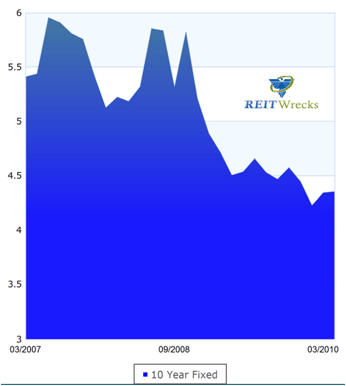
When this unprecedented government market manipulation comes to an end, and it is coming to an end now, single family mortgage rates will go right back to where they came from. As that happens home ownership will become even less affordable, and that means home prices are likely to drop even further.
But there’s much more….
As the Fed begins to unwind its historic intervention, it faces a second wave of toxic mortgage maturities that could be even more damaging than the last wave of subprime mortgages. These are the 3 and 5 year Option ARM mortgages, and they were the credit bubble’s absolute creme de la creme.
If you didn’t manage to get a piece of the action in Option ARMs, these were the mortgages given to credit-worthy borrowers who could not afford their monthly mortgage payment using a normal ARM (in other words, they paid too much for their home), and the Fed is waiving goodbye just as these Option ARMs get set to explode:
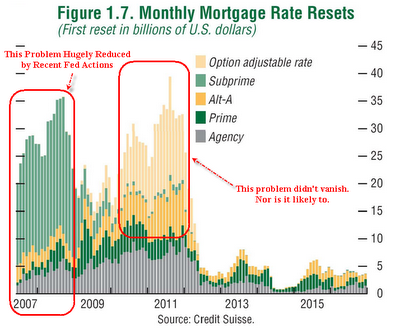
Not only did these loans require zero principal repayments, they also allowed borrowers the option of skipping scheduled interest payments altogether. As these loans reset in 2010 and 2011, that option goes away and principal amortization payments will kick in, adding hundreds of dollars to a borrower’s monthly mortgage nut.
And, with the Fed pulling the plug on its mortgage buying program, these loans will reset at rates that are far higher than the initial “teaser” rate. Sadly, this may spell doom for borrowers who used these loans to fund overpriced home purchases in 2006-2007, especially in high-priced markets along the coasts.
And there’s even more….
Terminating these programs are the Fed’s first tentative steps in a “tightening cycle like no other in its history”, according to Sacks. In a speech last week to the National Association for Business Economics, Sacks noted that the Fed faces “extraordinary challenge with this exit, given the historic steps that have been taken with the Fed’s balance sheet.”
He candidly admitted that the Federal Reserve’s largesse over the past two years has been so massive and so broad that tightening will need to be implemented on a scale that the Fed has “never before attempted”. He also said that the Fed will be operating in a framework that has not been fully tested in U.S. markets. What he did not say is that the Fed needs to take these steps, and fast, in order to prevent something even worse: inflation and yet another asset price bubble.
Unfortunately, there is no asset price bubble brewing in single family housing. Despite a glimmer of hope in the number of borrowers who had fallen behind in their payments in Q4, a record 15 percent of all homeowners with a mortgage had still missed at least one payment, and nearly half those borrowers were at least three months delinquent.
Three month’s delinquent is the point at which foreclosure proceedings commence, and this latter figure is more than double its typical level. The Fed has now run out of time, and its efforts to re-inflate housing are coming to an end in favor of fighting even more damaging inflation in the broader economy. This is not good news if you’re an underwater homeowner, and it looks house prices are going to get a lot worse before they get better.


ShareThis


{ 2 trackbacks }
{ 23 comments… read them below or add one }
”
Federal Reserve’s largesse
”
Precisely what I was suggesting 18 months ago. You do not need statistics. You do not need Fourier Transform. Horse sense is only thing you need to figure this. When bubble looses pressure, begins to implode, relax. Only after prices hit bottom, only then you re-inflate bubble. But after you re-inflate half-way back up to undistorted value you will need the moral courage to desist your tampering, to stop price supports. Then will be your job of locating the co-conspirators of fraudulent activity and begin prosecution for the remedy of havoc wreaked. They can run but no place to hide.
Has premature bubble repair with premature bubble re-inflation constituted attempt at fraudulent activity cover-up? Bailouts? Deflation Defense? Liquidity Repair of Dept Disaster? What will be their next ploy, their next smoke screen for obfuscation of fraud?
U B Judge
U B Gumshoe
“adding hundreds of dollars to a borrower’s monthly mortgage nut.” it’s actually worse than that. option ARM minimum payments were typically based on a ridiculously low interest rate, like 1%. After 5 years, the payment is recast into fully amortizing the principal balance, at a rate several points over LIBOR, which doubles or triples the borrower’s monthly nut. So, to modify the loan into something the borrower can afford means either extending the term or curtailing the principal balance. Or, adding unpaid interest to the principal of the loan. Extend, and pretend.
Thanks for this, and for all your interesting posts.
Can’t dispute the resets coming up—and the fresh pain this is going to generate—not to mention the backlog of silent foreclosures sitting out there vacant but unrecognized by the banks. But I wonder if some of the poison from these option ARM’s might not already have been sweated out? Who owns these things now, anyway? Some of these are probably lurking on the balance sheets of Wachovia or BOA (fully reserved against, ha ha…). But weren’t these the kind of raw meat that got tossed into the supposedly AAA mortgage bonds (or the CDO’s made out of the leftovers)? And haven’t these already been written down to zero? If you’re right that another wave is coming, who’s going to be left holding the bag? Banks? The mortgage insurers (did these borrowers pay PMI?)? Fannie and Freddie (surely this junk wasn’t agency eligible)?
As far as new supply, while you can imagine millions of folks in AZ and NV, hunkered down in what were once 800K homes, scraping together the teaser payments and marking off the months on the calendar until the rates reset, lots of them have long since given up the dream and walked away. Generally speaking, these neg am option arms were the same people who tended to default immediately for other reasons (Michael Lewis’s people living “one broken refrigerator away from financial disaster”). I’d bet that a big chunk of these upcoming resets are already off the books. Or so we all have to hope….
Time to do some math, folks. sorry ’bout that!
> But I wonder if some of the poison from these option ARM’s might not already have been sweated out?
To a small extent, yes. In addition to the 5 year recast (which we know is coming), there was also a maximum as to how much the loan balance could rise due to negative amortization (i.e. the difference between the rate the borrower paid on and the stated rate of the loan). That ranged from 110-125%. If you figure that the difference between stated and actual rates was 4%, about 0.33% of the balance gets added on every month. For loans issued 2005-6 with a 110% max neg am limit, that’s enough to trigger the payment reset and thus, default. In most cases, however, it is the time trigger that will kick in.
> Who owns these things now, anyway?
These things were tranched into junior and senior exposures. If junior, it’s possibly in a CDO, but it could just as well be in your bank’s treasury portfolio if it hasn’t already been written down. If senior, think insurance company or your state’s pension fund.
> And haven’t these already been written down to zero?
In order to reflate the banks, mark-to-market accounting has been suspended, so I guess it depends on who you are talking about as investor.
> If you’re right that another wave is coming, who’s going to be left holding the bag?
If Fannie and Freddie had Alt-A programs (I don’t know if they did) then it’s them. Otherwise, it’s non-agency bondholders. In either case, it’s most likely your taxpayer dollars footing the bill.
> Generally speaking, these neg am option arms were the same people who tended to default immediately for other reasons
No, you are conflating them with subprime borrowers.
Crabs, U B Gumshoe! It will be interesting to see what the loss severities are on these bonds. Time is definitely the trigger, and it’s coming.
la terre, I need to concur with crabs – you are conflating Option Arm borrowers with subprime, here is the point I made in the post:
These borrowers all had (have?) good jobs and good credit, but they stretched their paychecks to trade up in 2006-2007. These borrowers are not in Phoenix and Las Vegas, they are in White Plains and Palo Alto. My guess is that their relative financial sophistication and job stability will translate into a different foreclosure profile – more discreet short sales than “strategic defaults” and moving vans in the middle of the night.
As for who owns these things, only the Master Servicers know, and even then all they have is the name and account number of some nominee. Many of the original owners of these bonds are long gone.
Typically, when the loans default or are likely to default, the special servicers have been selling the loans in bulk pools. They will either liquidate completely, or on more attractive collateral they will offer financing. I saw this recently on an MF deal in San Diego, Midland was the servicer, but it is relatively rare.
Crabs studies these deals for a living so I’ll defer to him on this aspect, but since you mentioned Wachovia – one example of the original owners being long gone is Landcap’s purchase of some of Wachovia’s residential whole loans.
Wachovia basically financed 90% of the deal using an unconsolidated joint venture. This allowed them to get it off their books (and take the loss) but retain some interest in any future upside. If you want some more background, I wrote about that deal here
These were whole loans, but in the RMBS/CMBS realm “extend and pretend” is morphing into modify and hope (Crabs, feel free to jump in here..). Here is the scenario: A $100 million residential mortgage pool exists on a bunch of property originally valued at $120 million. The property is now estimated to be worth only $70 million. The loans are in special servicing, but the loans are still performing and it’s assumed that the borrowers want to hold onto the their homes.
The buyer of the loans will only pay an amount that represents the current market value of the property, so the special servicer splits the bonds into an A note, which represents current market value, and retains a future upside interest through a separate B note. It then sells the A note, and hopes it can sell the B note two-three years down the road (the assumption being that the borrower will find some way to completely pay off the original mortgage).
I know this scenario is already playing out on the commercial side, but I don’t know how common it is in RMBS. So far, I’ve only seen it occasionally on the commercial side. RMBS is a much bigger market though, and there is a lot of sh*t about to hit the fan in terms of loan maturities, so there are a lot of people like Crabs trying to figure out ways to figure it out.
Crabs, Wrecks, *thanks* for these very helpful clarifications! It’s a full-time job to get one’s mind around these things. I actually have a buddy in Stockton who bought in 2006, safe job, good credit, who’s sitting underwater on one of these ticking time bombs. Oddly, he’s not freaking out given that current interest rates are so low, and thus the reset looks doable. But here the first part of your article seems to be the kicker. It’s not just the resets, but the conjunction of these with rising interest rates (which is the hammer and which the anvil?) that’s going to do the damage. It’s amazing how free money salves the pain, and it’s obvious this can’t last forever.
Still, the contrarian in me wants to think that things, while getting worse, aren’t going to be as bad as the worst case scenario. Would be curious what you think about some of the reits formed to buy non-agencies (IVR, etc) or older reits like MFA and NYMT that have been selectively shifting into non-agencies (higher yield, no leverage, upside if the doomsday scenario doesn’t play out)? TCW’s TSI also looks interesting.
la tere – rates HAVE to go up. The dollar is declining, and the U.S. needs to finance the deficit by selling bonds to someone. If your friend has an Option ARM, which were interest only, not only will it reset at a higher rate, but he/she will have to start making principal payments. It’s a double whammy, one anvil and two hammers.
Inflation is the wildcard, but in a place like Stockton, it will be years before inflation has any effect on home prices. This means your friend and hundreds of thousands of others like him/her will not be able to ride inflation into a refi at par. And I am not just guessing about this; I have been on several field trips to see for myself.
I too am a contrarian, and I went very deep AGNC late 2008 early 2009. I wish I had held onto it a little longer. However, I went to an investor conference last year where presentations by mortgage REITs were standing room only. I’m sure it will be the same this year too, because the main question investors asked then will be even more pertinent now: what happens to you guys when rates go up? MFA presented, along with NYMT, CIM, RWT, DX and a few others. The answer was, “we don’t know”. (seriously!!)
Management at these REITs are certainly very knowledgeable and well qualified, and they will be able to manage their way through it, but it’s still the $66,000 question. The Fed gave them and the banks a free ticket in 2008 and 2009, but it’s all coming to an end. What’s more, it sounds like even the Fed is uncertain as to how it will all play out, based on what Saks is saying.
I am fascinated by it though, as I think most people are, and I will definitely be looking into NCT, RWT, NYMT and a few others.
Thanks for both of your comments; Crabs – your answer was a great read!
RW, thanks for the applause. thanks as well la terre, surtout si vous parlez cette belle langue .
First, to answer RW, the modifications being done in RMBS are typically done along HAMP guidelines. What they do (and this doesn’t apply to Option ARMs where the minimum debt service payments are already based on a ridiculously low rate) is drop the loan to a low fixed coupon like 2 or 3%, leave it at that rate for five years, and then step the rate up by 1% / year when presumably things will have improved. In some case, the servicer is adding the difference between the modified rate and the stated rate to the loan’s principal balance.
Although it seems counter-intuitive, rates don’t have to go up. Rates during Japan’s lost decade stayed low. As long as a Treasury auction doesn’t fail, rates can stay low for a really long time. But the option-ARM borrower will still be hosed. Let’s take an example from MARM 2006-OA2:
loan # 7770002808 : the original balance is 374,500.00, current balance 405,716.88 or 108% of orig. Recast happens at 115% or in 20 months, whichever comes first. The minimum payment is 1,550.41 which translates into a mortgage rate of 2.86% The stated rate on the loan is 3.5% over the 1 Year Average Treasury rate, a common index now at around 0.5%, thus 4% Assuming that the borrower has been making minimum payments every month (which is usually the case) every month
the mortgage balance increases by the difference between interest on the stated rate and the minimum payment = 1,787.92 – 1,550.41 = $237.51 so probably not enough to hit the 115% limit, so the payment will be recast in 20 months. By then, the loan balance will be 410,467 and the payment assuming rates don’t move goes on the now-25 year mortgage jumps to 2,166.60, a 40% increase in debt service even though rates haven’t risen. Holy WaMu, Batman!
What seems to be happening is that the Treasury is letting servicers do whatever they want. My guess in this case is that the servicers will just let the borrower keep making the minimum payment and the bondholders will get hosed. Which is what the bondholders fully deserve for lending money to these borrowers via these transactions. Except that it’s your state’s teacher’s pension fund!
Wrecks–thanks for the thoughts on the mortgage Reits. It sounds like we’ve been looking at the same kinds of things for the past year or two. AGNC is still my biggest holding, followed by NRF, which I know you also follow (and have great insights into). But I’ve dumped all the other agency reits, precisely for reasons you suggest: they’re pure plays on the yield curve, which has to come to an end…and it’s not going to be pretty when everyone’s running for the door.
Wow, crabs, that’s a terrifying glimpse into the belly of the beast! Sad to think that there’s a human story attached to each one of those numbers. But with the loan you picked, can’t one imagine two very different kinds of stories, with potentially different endings? Just spit-balling here, so let me know if I’m way off target.
One version is my buddy in Stockton, or some other middle class buyer in CA or Las Vegas who really stretched it out for that shiny new house in the builder development. The numbers and timing would be about right. Say they bought a house for around $400K, plunked down 5%, or maybe nothing, and borrowed the rest on your # 7770002808. Assuming they (or people like them) haven’t lost their jobs in the meantime, or simply done the math and walked away, they’re staring at a reset in twenty months and their house is now worth $150K, maybe. They obviously haven’t been able to refinance at a fixed rate in the meantime so deeply under water. Once they get that first payment notice for $2200 bucks, they will sigh a little bit, pack the bags, drop the keys into the mail, and say goodbye to their credit ratings. But they will walk away, and probably without a second thought. Or, in your scenario of an “enlightened” servicer, they’ll stick around and continue to make minimum payments, effectively renting from the lender rather than moving into an apartment. The point being that (a) there’s just no equity, and (b) the bondholders (and all of us!) are SOL.
But let’s imagine a different kind of option ARMer who fits more the Palo Alto or White Plains profile Wrecks sketched out above: someone with a secure, high paying job, good credit, financially savvy, and with some skin in the game. Young couple who owned a condo in the city with some equity in it, or a retired couple sitting on a capital gain on a house they bought in the 1960s, who sold this for a big profit and plunked 400K down toward an 1.1 mill house in a tony suburb like Bethesda or Evanston that they really couldn’t *quite* afford…
While I don’t think it’s going to be a Cinderella-style happy ending, this other option ARM story is going to end up somewhat differently because: (a) while they’ve tailed off a whole lot, home prices in White Plains, Palo Alto, and Bethesda (if these are your typical option ARMS) haven’t tanked to the point of making a refi impossible for someone who had some equity to start with; (b) with 4.5% on fixed mortgages for the past year or so, anyone who had decent income and some equity has long since shifted out of these option arms and into something with a fixed rate, assuming they can afford it; (c) but if they truly can’t afford the 40% bump, and if Wrecks is right about the profile of these option ARMers, these are the kind of savvy people who’ve long since seen the writing on the wall and taken pains to preserve whatever equity they might have by selling the house off, in which case it’s their equity that’s hosed, and potentially not the bondholders?
Does this story fit the facts, or am I hopelessly naive? If this isn’t totally off the mark here, the take-away points would be:
(a) Some (not insignificant?) fraction of the option arms originated during this period are already off the books, either fried or via refis, in which case the new pain will be (somewhat?) muted.
(b) It’s unclear what kind of selection effect this would have on those outstanding pools of bonds? Pension funds, keep your fingers crossed! On one view, the really absurd, non-sensical loans and the marginal loans would already have defaulted out via walkaways, job losses, etc, in which case the remnants would be disproportionately stronger. Or on the adverse view (probably more supported by my scenario above, actually…) the good, refinanceable loans and those backed with some owner equity are long since gone, leaving only the truly hopeless, underwater borrowers absolutely certain to default.
Wonder whether any of this corresponds to the reality on the ground/ in the computers? You guys are much closer to all of this than those of us on the outside who have to get our info third-hand via the CNBC cheerleaders.
tres chere terre,
Not not off the mark at all. In fact, for someone who actually pays attention to CNBC (I stopped about a year ago) your insight is remarkable. Again, most of the loans are still outstanding; no lender would refi these loans “merdeuses” . The answer is that, yes, there is some proportion of the option arm market which will be money-good. My thoughts are 15-20%. Not enough to avoid pension fund armageddon.
It’s a problem alright, but there’s really no problem somebody else’s money can’t fix. From today’s New York Times :
http://www.nytimes.com/2010/03/26/business/26housing.html?th&emc=th
And now this from the Saturday edition:
http://www.nytimes.com/2010/03/27/business/27modify.html?th&emc=th
A bit dramatic, I’ld say. Principal reduction is what should have been done all along, with the bondholders of securitized mortgages taking most of the hit. Those of us who kept our hands clean feel that this is unfair to the responsible borrower (who also gets helped by this program), and it is indeed unfair. However, regulatory blindness to predatory lending was a big part of the problem, which is why we all have to pay the price. This is America’s punishment for electing Bush, twice.
Crabs, not only did I keep my hands clean, but I sold every piece of residential real estate I owned in 2005. And I told guys like la terre’s friend in Stockton to do the same. For pete’s sake, I even sold short my banking job in favor of this ridiculous blogging gig. I did everything but buy canned food. However, as Margaret Thatcher famously said, the problem with socialism is that sooner or later you run out of other people’s money. And all you need to do is look at what Treasury rates have done since the Fed made these announcements. Nous avons un petit probleme, non?
Perhaps we should start studying Chinese instead.
Funny how far things have come! Where can I find a low-ball appraiser to come to my house and say it’s now worth less than my mortgages so I’ll qualify for a government handout, too?
The article hints that this whole thing is likely to be purely symbolic, involving only a few thousand token borrowers such that politicians can have political cover of helping homeowners and the unemployed going into elections, which are going to be a bloodbath. Also, banks like BOA get to look contrite and pretend they would actually participate in this for anything other than purely instrumental reasons. But this thing could really take off: imagine I’m a bank on the hook for a crappy, doomed mortgage I was dumb enough to keep on my own books. And the US govt is willing to refi this thing via FHA and take it off of my hands, even for a 25% haircut. Sign me up! Just watch how fast we can fill out the paperwork now.
La terre, that’s the great thing about this program. Because the govt has figured out that even responsible borrowers who are underwater are going to eventually make the economic decision to stop paying their mortgage, and that recovery values after foreclosure are much worse than principal forgiveness, you can apply for the handout too. Most residential mortgages have been securitized, and in most cases into agency securities (FN, FH or GN) which are govt-guaranteed. Mr Hu owns a lot of these, and he is most likely saying, I would rather get my bonds pre-paid than risk losses if FN or FH defaults. You may be aware that FH and FH just spent $200B of taxpayer money to do precisely that, to buy back all their delinquent mortgages and prepaying the bondholders in full. Does it suck? You bet. But what’s worse, buying back a couple of trillion dollars of underwater mortgages, or to continue to see all taxpayers wealth collapse because of downward pressure of foreclosures on the housing market? The govt is saying that we can afford another couple of trillion of debt because it still won’t exceed US GDP ($15T) and it prevents the system from blowing up (i.e. a FN or FH default). It’s probable that China signed off on this before they agreed to buy more bonds from the US.
Two things that may of interest. First, upward an onward – if you will:
Second, the S&P 500 is going UP in response, not DOWN:
If this is all to be believed, the stock market is anticipating rising rates as a sign of increased economic activity, not armageddon. Perhaps I didn’t need the canned food after all.
REIT Wrecks, just wanted to jump in here and say keep up the great work. I really enjoy reading your blog and all of these comments.
Thanks, Geoff
RW, let’s all hope this is one case where correlation really does imply causality! But I fear that beyond some tipping point that correlation is going to break down in a really ugly way.
Crabs, On the FN and FH dilemma. Yep, those payouts are what scared me out of nearly all the Agency REITS. If you’re a Chinese bondholder who bought at or below par, then having Fannie and Freddie come clean and make good on all the bad mortgages is great (though you now find yourself holding cash that you’ll have to find someplace to reinvest at a lower rate). But if you bought into these things at above par, and leveraged them up 7 times over, like some of the agency REITS, then an influx of early payouts is a disaster in the making. ANH and CMO don’t think like the Chinese, apparently.
But this only gets at the deeper question, really, of why anyone would be dumb enough to write a mortgage in the first place–absent a secondary market–or to buy an MBS in the secondary market. If you think about it, it’s only based on a collective delusion that any kind of private secondary market for MBS exists. I always think about a mortgage as a severely loaded bet between you and the lender (or MBS buyer) over interest rates. Why would anyone be willing to lend someone $500K at 5% for as much as 30 years, knowing full well that right off the bat inflation is going to eat into a portion of that yield; that the person on the other end of the bet can always get out of it for free (and will almost certainly do so when they’re losing) ; and (what we now know in hindsight) that the fixed interest rate of even the best of these “AAA” securities doesn’t adequately price in either the risk to principal loss or the political uncertainty surrounding the market or the credit worthiness of the “guarantors.” Unless you know that there’s some sucker in a state pension fund, insurance company, Chinese bondholder, or–ahem, cough–the US govt who is willing to take this off your hands the moment the bet goes south, no one–I repeat, no one–would be willing to make this bet at anything even approaching today’s “market” rate for mortgages.
If the US govt wants to keep up this charade of cheap, easy money to fund home purchases, the sad, scary reality is that nearly all of this stuff is going to end up either guaranteed by the US govt or on its actual balance sheets, including some of the worst of what was already done privately.
Save some canned food for me, RW!
M. ou Mme. Terre,
Lending at 5% for 30 years seems like a bad deal, except if you compare it to investing in US Treasury bonds at 4.5% for 30 bonds. Taking customer deposits to do so is indeed a bad deal. The technical term for it is disintermediation, and it was one of the main causes of the 1970s S&L crisis which led to the creation of the RTC. Sure enough, you can rely on Citibank to repeat the mistakes of history with their SIV issuance (selling commercial paper to fund ultra-long CDOs. These cathedrals of finance were designed to reduce their reserve requirements.).
Sorry, I’m straying. Remember, if banks pay 1% on deposits and lend at 5% on mortgages, that is 4 point spread of free money. With mortgage rates at 5%, almost all MBS are premiums (i.e. priced over par). Yes, it sucks when premium investments prepay at par, except when you are worried about getting back any of your principal!
epic fail is comming followed by another distraction so the bad economy will be blamed on it !
I’m not saying you’re wrong if you’ve retired at 26 but can you share your thoughts with the rest of us?
You’ll always notice that there seems to be some impending doom about to hit.