
As the world was coming to an end in March of 2009, REITWrecks wrote a rather forward-leaning post entitled REIT Stocks: 4 Ways to Play the Carnage.
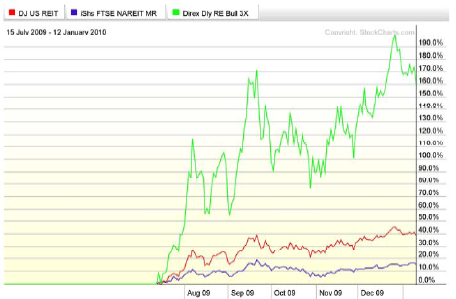
REITs have rallied strongly since then, and even more strongly since Direxion launched its new levered REIT ETF series in early July. The launch could not have been more well timed. DRN (shown in green, below) is up more than 160% in just six short months:
However, our somewhat disturbing obsession with Real Estate Investment Trusts shouldn’t obscure a basic truth: REITs are strongly correlated to the broader stock market, and they are often even more volatile than stocks. If you are an asset allocator seeking diversification, and you include REITs as a substitute for direct investments in real estate, your portfolios suffered badly in 2008 and 2009.
Although REITs were thought to help Mom and Dad sleep soundly, Freddy Krueger can actually make a lot of noise in the inky black night. In the darkest days of September 2008 through March of 2009, according to the Wall Street Journal, the Dow Jones Equity All REIT Index closed up or down by more than 5% on 64 occasions. REITs are typically more volatile than direct investments, but this kind of volatility is unprecedented. Since its inception in 1990 through the end of 2007, that had happened only three times.
As far as correlation goes, not only did REITs experience three times more negative return years than privately held real estate (1972-2000), but the magnitude of negative REIT returns was much greater than privately held real estate (read the full study here). What’s the last word on correlation? Why bother with words when one can simply use pictures. Compare Direxion’s performance chart above with Moody’s Real Property Price Index below:
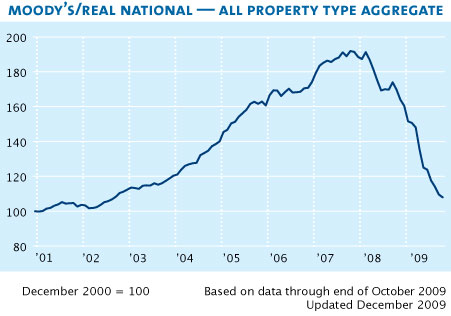
What’s the point? Simple: it’s time to buy commercial real estate. If you’re an asset allocator, REITs are a flawed substitute for direct investments in real property. However, they are also known as a leading indicator for the real property markets, and REITs often lead real property into and out of deep valuation troughs. If you use REITs as a substitute for direct investments in real estate, it may be time to re-evaluate that strategy and buy the real thing.

reits investing
reits
reit stocks


ShareThis


{ 5 comments… read them below or add one }
Well said. REIT equity had a good few months, but nothing supported by any fundamental change other than their astounding ability to actually raise more equity/debt even in this environment. BUT, I'd run for the hills from most REIT equity right now. I'd argue REIT debt is a better trade, and in some cases a higher yield oddly enough, but I'm not a buyer of it at these levels either. CMBS is still outperforming, and overall has a better risk position as the GGP deal has proven.
I think things are bottoming out.
Concrete Jungle – thanks. For readers who may not be aware of it, Concrete Jungle writes The CRE Review, which is a great blog on commercial real estate and commercial real estate debt. If you are interested in CRE and CMBS, you'll love the blog.
RW,
Good to see you back and in force.
Over 9% of loans in CMBS are now in workout/modification mode. All this supply hasn't hit the market yet, most of it isn't yet REO. Don't you think that implies that we have further down to go?
Not sure Crabs (if you please), and I operate now with a much different perspective than the one I had in my banking days, but in my opinion that simply means there will FINALLY be more stuff for sale, not that prices are still falling off a cliff (more on why prices are falling here).
On the demand side, there really is sh*tloads of money sitting on the sidelines, and there really is still a face off between buyers and sellers. And those who don't have to sell just aren't selling.
A friend who manages a university endowment went into 2009 with $30 million in open commitments to more than 10 real estate funds, and he ended the year at $28 million open. The reason? capital calls to pay management fees, nothing else – not one fund did a deal last year.
I spoke to a partner at one of the largest apartment management companies in country last week (privately held); they have plenty of internal cash earmarked for acquisitions, and they manage a $50 million, largely un-invested discretionary fund. Nevertheless, they only did one deal all year – and that was at a 7 cap on an A- property in Central Florida, hardly what I would call exciting. He said it was very challenging to find well-priced deals.
A broker I speak with in the Midwest has 20 offers on a 492 unit (you'd need to hire a mayor to manage the place) soon-to-be-bank owned C property, but the bank is not a forced seller, and they may decide just to run the place and wait it out.
Another broker in Southern California has 20 offers on an A-/B+ property, many of which were far above initial expectations, but the seller, a certain CMBS servicer located in Kansas, believes time is on their side and won't pull the trigger.
We made an all-cash, 30 day close type offer on a non-institutional deal (under $10MM; tertiary market) but the seller has been la di da-ing all month long while they sit back and collect their rent checks….
The one exception to this may be land deals, but there is still plenty of cash being thrown at raw land even in Arizona, and I can send you the bid sheets….
I think part of the reason for this is that there is so much more data available now than in 1990, and a lot of it has been democratized by the internet. Most people can see what's happening in almost real time, not only with loan maturities, but also with demographics and the development pipeline. Consequently, there has been a ton of money raised against the opportunity, but no sensible seller will give away 20% IRRs.
I personally have been waiting for 2010 since late 2005, and fervently so since late 2008. However, my partners and I now think it's going to be a slow burn of bad deals over several years into a pirannha pond of private equity, and we'll need to be just as careful as we were in 2006.