
Commercial Real Estate Loan Originations Show Continued Deterioration in CRE

by REIT Wrecks on May 15, 2009

The Mortgage Bankers Association has released their quarterly survey of commercial/multi-family loan originations, and it shows continued dramatic deterioration in all CRE lending sectors, including an 80% plunge in bank lending.

Earlier this week, I wrote that commercial real estate transaction volume had declined to practically zero, so it’s no surprise that loan originations would show a concurrent decline, but that decline was precipitous: Q1 loan originations declined to the lowest quarterly level in the 7-year period covered by the survey.

The report is unclear as to which tail is wagging this dog, however. Is the decline in loan volume the result of “suicide-tight” underwriting, or simply a lack of buyers transacting on new deals? Anecdotally, there is a lot of equity sitting patiently on the sidelines at the moment, so it’s likely the latter. In addition to the 80% decline in bank lending, insurance company loan activity declined by 66% and GSE lending dropped by 26%. It was so bad, I decided to paint a picture. the things I do for you
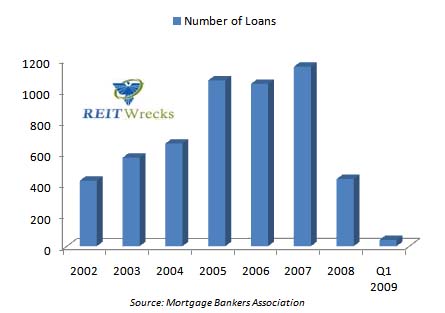
commercial real estate loan origination volume 2002-2009
There were some intriguing data in the survey though (read the full report here). One interesting finding is that while all loan activity decreased, industrial loan activity this quarter decreased the least vs. the year ago period, even less than multi-family. In fact, industrial loan activity from Q4 to Q1 actually increased by 67%. With loan capital still flowing into that sector, well capitalized industrial REITs are still relatively healthy.

Indeed, industrial REIT yields are among the lowest in the sector. This should enable industrial REITs to recover more quickly. Unfortunately, that is small comfort to those who lost their shirts betting on the likes of Pro-Logis (PLD). It’s also a sign of hope around increased economic activity, and probably of inflation as well…

Not surprising is that Fannie Mae and Freddie Mac continue to be practically the only game town for apartment lending, which declined by 61% in the quarter from one year ago. Hotel loans were down a whopping 88%, followed by healthcare (down 80%), retail (down 76%) and office lending (down 66%). Aside from the good news for industrial REITs, the only other obvious silver lining is that the rate of decrease in activity has slowed. So things aren’t getting much worse, but it’s still awfully hard to see anything even remotely shaped like a “V” on the horizon.

REIT Investments


Email, Print, PDF and/or Share:
  • email
  • Print
  • PDF
  • RSS
  • LinkedIn
  • Facebook
  • Google Bookmarks
  • Twitter
  • StumbleUpon
  • del.icio.us
  • Mixx
  • NewsVine
  • Live
  • Yahoo! Buzz
  • Yahoo! Bookmarks
  • Technorati
  • Netvibes
More on this topic (What's this?)
A Matter of Time
Read more on Commercial Real Estate, Care Investment Trust, Loans at Wikinvest

ShareThis

{ 2 trackbacks }

The Coming Bust In Commercial Real Estate: Why Developers Are Desperate For the Dole | REIT Wrecks
March 27, 2010 at 12:19 pm
Multifamily Financing Challenges | CommercialMortgageLoanModifications.Com
March 27, 2010 at 12:50 pm

{ 1 comment… read it below or add one }

1 REIT Wrecks March 30, 2010 at 9:28 am

crabsofsteel said…
Does anyone know if Fannie or Freddie are still writing full-term interest-only loans? Lots of those (over $1B) done in 06-07 have already blown up (see Babcock & Brown, Bethany Group)

May 16, 2009 7:23 AM

=====================================================================
REIT Wrecks said…
Hey Crabs of steel if you please, welcome back. I replied, tongue in cheek, to your last comment on the REIT Dividend post. Those AIMCO “deals” in Ohio are poster children for the bid-ask spread phenomenon.

I haven’t heard of Fannie Mae offering any interest only product on propery-level deals this year. They do offer 7 year capped floaters, but 10 year fixed FNM deals are closing around 5.25%, so I think most people would avoid the added risk of a shorter term IO (even if it were being offered) or floater in favor of locking in 10 year money.

BTW, The Babcock deal was ideed a floater but for the sake of good order it was not a Fannie Mae deal. It was underwritten by GE and securitized via Credit Suisse.

One of the B&B principals involved in the acquisition of the Alliance portfolio (the one now in default) is a friend of mine, and while he is a great guy, as well as a smart guy, he knew nothing about apartments other than what the brokers told him.

So they took the broker pro-forma, signed the contract and financed those “cash flows” with an 84 month I/O, with a $15MM piece of Mezz thrown on top for good measure. In early 2008, as the end was drawing near, they would start off meetings by saying what a great job they had done on the financing – locking in an 84 month I/O at 5.25%…and that it was assumable at the right price!

May 18, 2009 8:27 AM

===============================================================
crabsofsteel said…
Wrecks,

They do write full-term interest only loans but it’s not what you think. Just about every CMBS deal since 2002 had a class that was backed solely by cashflows from a group of loans which were FN or FH approved. FN or FH would then buy the bond, which is the same for them charterwise as originating the loan. Except that they could now own loans which were not written to their standards. So even though GE originated Babcock, FN or FH funded it, and owns it. Usually it was FH.

I/O loans are great ideas, until they aren’t.

Leave a Comment

You can use these HTML tags and attributes: <a href="" title=""> <abbr title=""> <acronym title=""> <b> <blockquote cite=""> <cite> <code> <del datetime=""> <em> <i> <q cite=""> <strike> <strong>

Previous post:

Next post: